

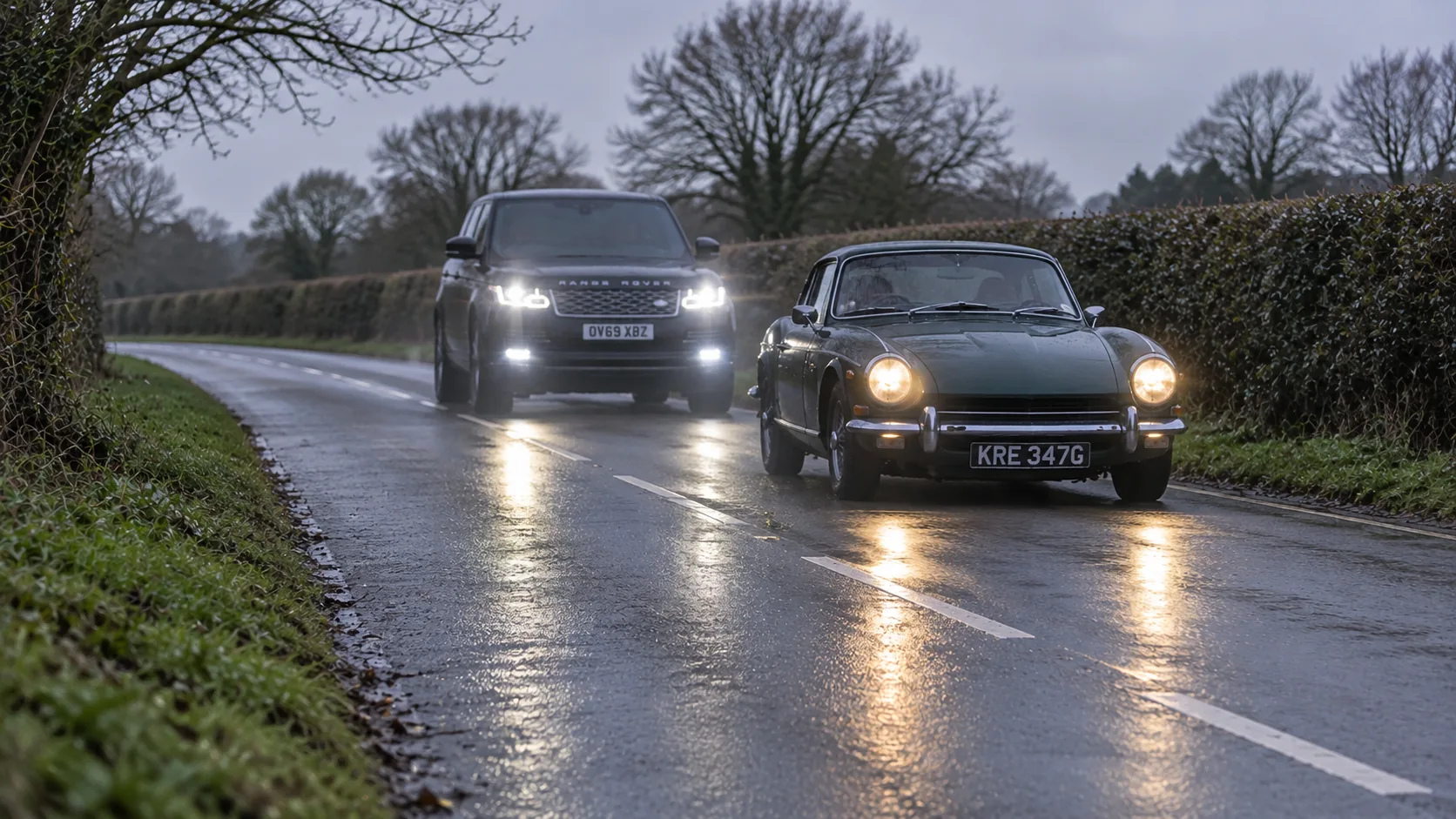
A brighter future for classic car lighting? New MOT rules could make upgrading your headlights considerably easier.
Anyone who regularly drives a classic car after dark will know the limitations of traditional headlights. What might have seemed perfectly adequate when the car first left the factory can feel rather lacking on today’s roads, particularly when faced with modern vehicles equipped with powerful LED lighting.
For years, owners wanting to upgrade their original halogen headlights to LED bulbs have had to navigate a rather confusing set of MOT regulations.
However, that could be about to change.
New MOT rules from October 2026
From 14th October 2026, changes to the MOT inspection rules in England, Scotland and Wales allow certain ECE-approved LED replacement bulbs to be used in compatible halogen headlamp units.
The change, announced by the Driver and Vehicle Standards Agency (DVSA) on 13th October, provides an opportunity for owners of eligible vehicles to improve their lighting without necessarily replacing their original headlamp assemblies.
Previously, the MOT inspection manual prohibited LED conversions in halogen headlamps on vehicles first used on or after 1st April 1986.
The important distinction is that this isn’t permission to fit any LED bulb you find online. Only qualifying, approved replacement bulbs are covered.
It’s all about the approval
There is an important requirement that owners need to understand before purchasing anything.
Approved LED replacement bulbs must come with a manufacturer-issued approval sticker. This must be permanently attached to the vehicle and positioned somewhere readily visible to the MOT tester.
The sticker identifies the approved bulb and includes details such as its category, voltage, manufacturer and approval number, alongside a security feature.
If the sticker is missing, unreadable, appears tampered with or doesn’t correspond with the bulb fitted, the vehicle will fail its MOT.
And, of course, the normal headlight checks still apply. A correctly approved bulb doesn’t automatically mean a correctly adjusted headlight. Beam patterns, alignment and glare remain important considerations.
The changes apply to vehicle classes 3, 4, 5 and 7, covering most cars and light commercial vehicles.
Motorcycles, HID conversions and complete replacement LED headlamp units are not included in this particular change.
Will this work with your classic?
This is where things get a little more complicated.
Just because your classic uses a familiar H4 or other halogen bulb fitting doesn’t mean an approved LED replacement is available.
Approval is specific, and a bulb advertised as road legal in another country isn’t necessarily compliant with the new UK MOT requirements.
Before spending your money, check:
- Is the exact LED bulb ECE approved?
- Is it approved for your particular headlamp application?
- Does the manufacturer supply the required approval sticker?
- Can the supplier confirm that it meets the new UK MOT requirements?
Don’t assume that because a bulb fits physically, it is automatically suitable.
Should you upgrade your classic’s headlights?
For owners who regularly use their classics, particularly during the darker winter months, improved lighting could make a noticeable difference to night-time driving.
The good news is that retaining the original headlamp housings means you don’t necessarily have to change the appearance of your car.
Those familiar round headlights, chrome surrounds and period styling can remain untouched.
However, before buying replacement bulbs, it’s worth checking the condition of your existing lighting system.
Old reflectors, deteriorating connections, poor earths and tired wiring can all contribute to disappointing headlight performance. Sometimes the best starting point isn’t a new bulb at all.
It’s also worth speaking to your insurance provider before making lighting modifications, as your policy may require you to declare them.
The Classic Auto Works verdict
This is a potentially useful development for classic car owners, but don’t rush out and buy the first LED conversion kit you see advertised.
The new rules provide an opportunity, not a blanket exemption for aftermarket LED bulbs.
For anyone running a classic regularly, better lighting is certainly worth investigating. Just make sure the parts you buy are genuinely approved for your application.
After all, there’s little point having a classic car that looks fantastic on the driveway if you can’t see where you’re going when you drive it home.
Classic Auto Works – Keeping classics on the road.
ClassicAutoWorks.co.uk